
Pulsed Field Ablation (PFA) — The New Standard in AF Treatment
PFA is the most significant advance in atrial fibrillation treatment in a decade. Non-thermal. Tissue-selective. Faster procedure. Superior safety profile. Now available at HRHF Clinic — western India's largest PFA experience.
Dr. Rajesh Dhopeshwarkar was among the first electrophysiologists in western India to perform Pulsed Field Ablation, using the Varipulse system integrated with Carto 3 electroanatomic mapping. Every PFA procedure at HRHF Clinic benefits from real-time 3D mapping, precise catheter navigation, and complete contact confirmation — the same standard as the world's leading EP programmes
What is Pulsed Field Ablation? — A Fundamentally Different Way to Treat AF
What is Pulsed Field Ablation? — A Fundamentally Different Way to Treat AF
Catheter ablation for atrial fibrillation has been performed for over two decades using thermal energy — radiofrequency ablation uses heat, cryoablation uses extreme cold. Both work by creating scar tissue around the pulmonary veins, electrically isolating them from the rest of the heart. Both carry a small but real risk of collateral damage to structures adjacent to the heart — the oesophagus, the phrenic nerve, and the pulmonary veins themselves.
Pulsed Field Ablation works on an entirely different principle. Instead of heat or cold, PFA uses brief, precisely calibrated electrical pulses — pulsed electric fields — to destroy cardiac muscle cells through a process called irreversible electroporation. Pores form in the cell membrane, causing the cells to die.
The critical difference: cardiac muscle cells are exquisitely sensitive to this process, while the oesophagus, phrenic nerve, and pulmonary vein tissue are largely resistant to it. The result is ablation that is more selective, faster, and carries a significantly reduced risk of the complications that have historically made AF ablation technically demanding.
PFA vs Conventional RF and Cryoablation — Side by Side
| Aspect | Conventional RF / Cryo | Pulsed Field Ablation |
|---|---|---|
| Energy type | Thermal (heat or cold) | Electrical pulses — non-thermal |
| Tissue selectivity | Affects all adjacent tissue equally | Selective for cardiac muscle cells |
| Oesophageal risk | Present — most feared complication of RF | Dramatically reduced |
| Phrenic nerve risk | Present — particularly with cryo | Dramatically reduced |
| Pulmonary vein stenosis | Small but recognised risk | Not observed |
| Procedure time | 90–150 minutes typically | 60–90 minutes typically |
| Lesion durability | Good — established long-term data | Excellent — emerging durable data |
| AV node risk (re-do) | Present if ablating near septum | Reduced due to tissue selectivity |
The bottom line for patients
PFA does not change the goal of AF ablation — pulmonary vein isolation remains the target. What PFA changes is how safely and quickly that goal is achieved. The most feared complications of conventional ablation — oesophageal injury and phrenic nerve palsy — are dramatically reduced. The procedure is faster. And the selectivity of the energy means that what needs to be ablated is ablated, and what should be left alone is left alone.
Is PFA Right for You? — The Patients Who Benefit Most
PFA is now our first-line approach for AF ablation at HRHF Clinic. The majority of patients referred for AF ablation are candidates for PFA — but the decision is always made individually based on the type of AF, the anatomy, and the clinical history. These are the patient groups where PFA offers the most compelling advantages over conventional approaches.
PFA at HRHF Clinic — Varipulse with Carto 3
HRHF Clinic performs PFA using the Varipulse system — Biosense Webster's PFA platform, integrated directly with the Carto 3 electroanatomic mapping system. This integration is what distinguishes the HRHF approach from simpler PFA setups.
Before PFA energy is delivered, the left atrium is mapped in high density — typically 2,000 to 2,500 mapping points — creating a precise 3D anatomical reconstruction of the chamber, all four pulmonary veins, and their individual anatomy. The Varipulse catheter is then navigated under real-time Carto guidance to each pulmonary vein, where pulsed field energy is delivered circumferentially.
The result: every PFA procedure at HRHF Clinic combines the speed and safety of pulsed field energy with the anatomical precision of 3D electroanatomic mapping — the same combination used at the world's leading EP centres.
What Varipulse + Carto 3 means for you
Conventional PFA systems deliver energy without detailed mapping — the anatomy is estimated from fluoroscopy. The Varipulse–Carto 3 combination creates a full 3D model of your heart before any ablation energy is delivered, confirming the catheter is in exactly the right position at each pulmonary vein, and documenting the complete lesion set after. You leave the procedure room with a complete record of where every ablation point was delivered — and so does your clinical team.
Case in Focus — PFA at HRHF Clinic
65-Year-Old Male · Paroxysmal AF · Structurally Normal Heart · First Procedure
A 65-year-old gentleman presented with symptomatic paroxysmal atrial fibrillation — palpitations and fatigue affecting his quality of life. His heart was structurally normal on echocardiogram. He had not undergone any prior ablation. PFA was offered as first-line therapy.
Pre-procedure
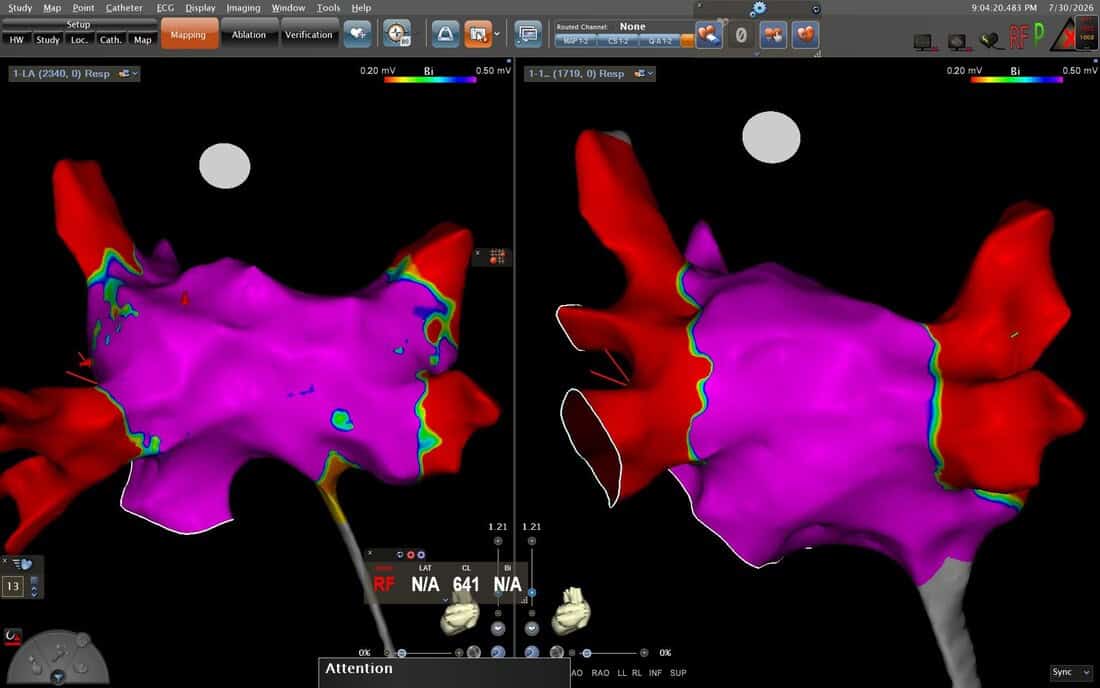
High-density mapping of the left atrium with 2,340 Carto points defined the precise anatomy of all four pulmonary veins and the left atrial body. The activation map confirmed AF with a cycle length of 641ms. This detailed pre-ablation map is what allows precise, personalised PFA delivery — the catheter position at each vein is confirmed against the 3D anatomy before energy is applied.
PFA delivery
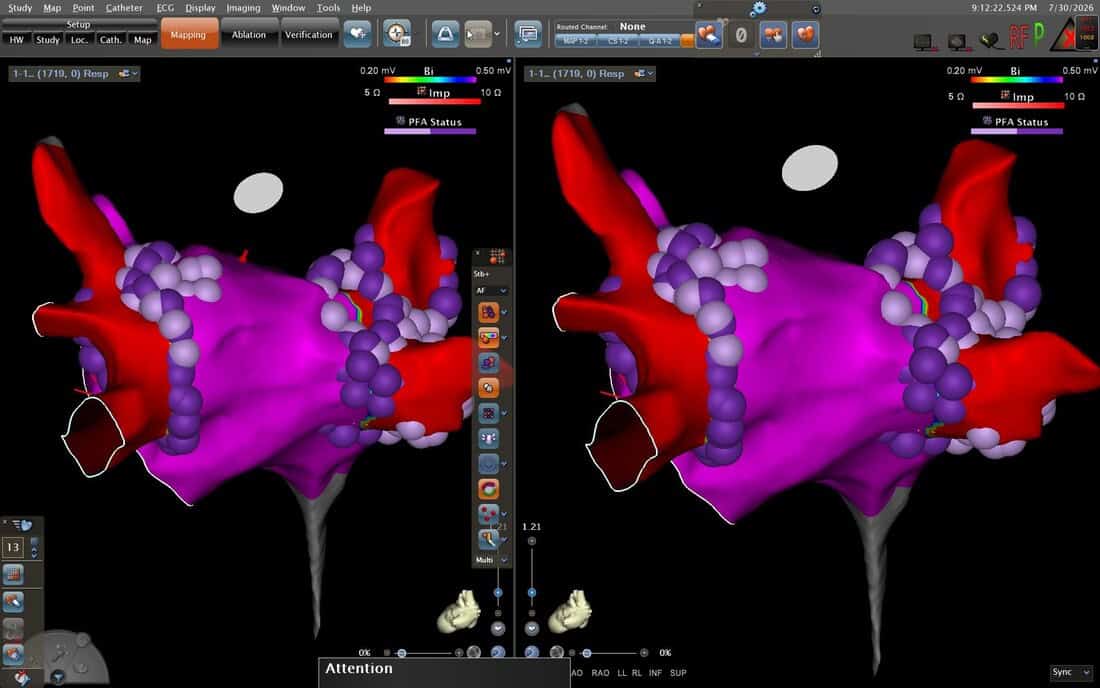
Varipulse PFA was delivered circumferentially around all four pulmonary veins under Carto 3 guidance. The post-ablation map confirms the complete lesion set — the characteristic dense cluster of purple spherical tags encircling each vein pair, confirming complete pulmonary vein isolation. No thermal energy was used. Procedure completed within 90 minutes. Patient discharged the following morning.
Watch: PFA Case Walkthrough
Watch Dr. Dhopeshwarkar Walk Through a PFA Case at HRHF Clinic
The PFA Procedure — From Consultation to Discharge
-
Pre‑procedure
Review of your AF history, ECG, Holter recordings, echocardiogram, and anticoagulation status. Discussion of AF type, anatomy, PFA as first-line option, and expected outcomes. Anticoagulation instructions given
-
Day of procedure
Admission in the morning. Sedation administered — you are comfortable and largely unaware throughout. Transseptal puncture to access the left atrium from the right side. High-density mapping followed by Varipulse PFA delivery to all four pulmonary veins. Procedure time 60–90 minutes.
-
Recovery
Monitoring in the recovery area for several hours. Most patients eat and walk by evening. Telemetry overnight.
-
Discharge
Typically the morning after the procedure. Anticoagulation continued — do not stop blood thinners until specifically instructed. Written discharge instructions provided.
-
Blanking period
The first 3 months after ablation is the blanking period. AF episodes during this time do not necessarily indicate failure — the heart is still healing. Continue anticoagulation throughout.
-
First follow-up
6 weeks after discharge — ECG, symptom review, anticoagulation decision. Further review at 3 months — formal assessment of ablation success.
Common Questions About PFA
No. PFA is performed under sedation. You will not feel the energy delivery. Some patients feel minor palpitations from the catheter manipulation, but the PFA pulses themselves are not felt.
Cardioversion uses a large electrical shock delivered to the outside of the chest to restore normal rhythm temporarily. PFA uses precisely targeted microscopic electrical pulses delivered from a catheter inside the heart to create permanent scar at specific locations. They are completely different procedures with different goals.
Clinical trial data and real-world experience show freedom from AF at 12 months in approximately 75 to 85 percent of paroxysmal AF patients after a single PFA procedure. These rates are comparable to or better than conventional ablation, with a more favourable complication profile.
Some patients require a second procedure — either because AF recurs after the blanking period, or because additional substrate beyond the pulmonary veins needs to be addressed. The rate of second procedures after PFA is similar to conventional ablation for paroxysmal AF.
Referring Your AF Patient for PFA Evaluation
HRHF Clinic accepts PFA referrals from across western India. All PFA procedures are performed personally by Dr. Rajesh Dhopeshwarkar — DM Cardiology (AIIMS), FHRS, CEPS — using the Varipulse system with full Carto 3 integration. Western India's largest PFA experience.
-
Symptomatic paroxysmal AF as first-line PFA
-
Persistent AF where PFA is preferred
-
Re-do AF ablation after failed conventional ablation
-
Patients with oesophageal concerns avoiding thermal ablation
AF can be treated. PFA makes it safer and faster than ever before.
HRHF Clinic offers western India's largest PFA experience — Varipulse with Carto 3. If you have been living with AF, a consultation is the first step toward a life without it.